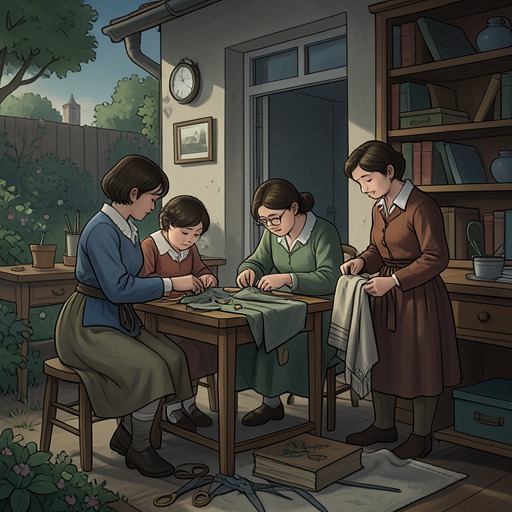
Mrs. March
Little WomenMrs. March is the sustaining center of the March family, combining tenderness with ethical authority. Her household is poor and her husband is away serving as a chaplain during the war, yet she refuses to let deprivation dissolve the family’s unity or purpose. Through daily care, urgent action in crisis, and carefully chosen counsel, she teaches her daughters that love is not merely an emotion but a form of labor, discipline, courage, and responsibility.
Identity and Place in the Family
Mrs. March first appears as a tall, motherly woman whose gray cloak and unfashionable bonnet conceal, in her daughters’ eyes, “the most splendid mother in the world.” Her presence immediately changes the atmosphere of the room: she asks after each girl’s work and health, settles herself with Amy on her lap, and allows the sisters to serve her while she enjoys the happiness of being home with them. Her maternal authority is therefore not remote or ceremonial. It is expressed through intimate knowledge of individual needs, physical affection, and an ability to make ordinary domestic arrangements feel secure.
The family’s circumstances make that security hard-won. Mr. March is far away where the fighting is, and the girls understand that he may not return for a long time. Mrs. March has also accepted the discipline of wartime scarcity, proposing that the sisters go without Christmas presents because the winter will be difficult and soldiers are suffering. She does not treat sacrifice as a demand imposed from above; she presents it as a modest contribution available even to people who cannot directly aid the army. The family’s poverty is real, but it is not allowed to become the measure of its worth.
Her principles are also visible in the family’s response to financial loss. After Mr. March loses his property while trying to help an unfortunate friend, Margaret March and Josephine March are permitted to work toward their own support. The Marches refuse, however, to exchange their daughters for the possibility of wealth when Aunt March offers to adopt one of them. Their answer is that they will remain together and be happy in one another. Mrs. March thus belongs to a household where affection takes precedence over inheritance, and where economic hardship is met by labor rather than by surrendering family bonds.
Moral Education and Emotional Discipline
Mrs. March’s most important work is the moral education of her daughters. When Josephine March is overwhelmed by remorse after Amy Curtis March falls through the ice, Mrs. March does not dismiss the danger or excuse Jo’s temper. She comforts her frightened daughter while directing her toward a lifelong practice of self-mastery: she must watch and pray, continue trying, and never decide that conquering her fault is impossible. The lesson joins compassion to accountability. Jo is not defined by the outburst that endangered her sister, but neither is she allowed to imagine that good intentions alone have cured it.
Mrs. March also turns childhood play into a language for adult conduct. Recalling the sisters’ performances of The Pilgrim’s Progress, she describes their old journey through the house from the City of Destruction to the Celestial City, with burdens, lions, Apollyon, and the valley of hob-goblins along the way. The memory becomes more than nostalgia. It gives the family a shared moral map in which everyday temptations and sufferings can be understood as stages in a continuing pilgrimage. The girls’ burdens are domestic, emotional, and financial, but the structure of the allegory teaches them to travel onward together.
Her guidance about womanhood is similarly ambitious without being worldly. When Margaret begins to think about admiration, lovers, and marriage, Mrs. March explains that she hopes her daughters will be beautiful, accomplished, good, loved, respected, wisely married, and useful. She does not reject marriage, but she rejects the idea of marrying rich men merely for wealth or possessing splendid houses that lack love. Her ideal joins affection, duty, and domestic happiness, making marriage valuable because it is grounded in love rather than status.
Mrs. March’s expectations are individualized rather than uniform. She asks Margaret March to be prudent and watch over the others; Josephine March to be patient, avoid despondency and rashness, and write often; Elizabeth March to find comfort in music and remain faithful to small home duties; and Amy Curtis March to help, obey, and stay safely at home. The family is treated as a cooperative structure in which each daughter’s temperament requires a different form of guidance.
Wartime Responsibility and Crisis Leadership
The war shapes Mrs. March’s motherhood even when she is physically at home. Her daughters admire Mr. March for serving as a chaplain despite being too old for the draft and not strong enough to be a soldier. Josephine wishes she could serve as a drummer or nurse, while Elizabeth knits an army sock and resolves to fulfill the duty nearest at hand. Mrs. March’s household becomes a civilian counterpart to the military world: its work, restraint, and emotional endurance are presented as meaningful forms of service.
This principle becomes urgent when a telegraph announces that her husband is very ill and that she must come at once. The message turns the cheerful household into a scene of shock. Mrs. March first collapses under the news, but almost immediately converts fear into a nursing plan. She tells Josephine to notify Mrs. King and gather supplies, sends Elizabeth to James Laurence for bottles of old wine, instructs Amy to have Hannah Mullet bring down the black trunk, and asks Margaret to help find her belongings. Writing, thinking, and directing at the same time nearly overwhelm her, yet her response reveals the practical intelligence beneath her gentleness: she knows that hospital stores may be inadequate and that her husband must receive the best care available.
Before leaving, she entrusts the girls to Hannah Mullet and James Laurence, asking them to take the trouble rightly. She forbids idleness as a form of escape and gives them the principle that defines her household: “Hope and keep busy.” Work is not presented as mere economic necessity. It is a blessed solace, a way to endure uncertainty without surrendering to fretfulness, and a means of remaining connected to duty. Her reassurance that the girls will never be fatherless extends family protection beyond physical presence and turns communal care into a moral fact.
Work, Independence, and Domestic Economy
Mrs. March’s example permits her daughters to regard women’s work as honorable. Margaret works as a nursery governess and suffers acutely from the poverty that keeps pretty clothes, social pleasures, and former comforts out of reach. Josephine accepts service with Aunt March even though the arrangement is disagreeable, because it is the best available work and eventually develops into a tolerable, even affectionate relationship with her irascible relative. Later, Josephine considers going to New York to teach children and sew in Mrs. Kirke’s household, defending the plan as honest work of which she is not ashamed.
The same ethic supports Josephine’s literary ambition. When “The Rival Painters” is printed, Mrs. March joins the family’s celebration of the publication. Josephine explains that the newspaper has not paid her as a beginner but has offered practice and promised payment when her work improves. Her deepest hope is to become independent and help the girls, and the family’s praise makes the first publication feel like a step toward that end. Mrs. March’s household therefore treats women’s labor as both moral training and a possible route to economic self-support, even while preserving affection as the central measure of success.
Mrs. March’s influence extends beyond immediate survival to future institution-building. When Josephine later proposes opening a school for boys at Plumfield, a happy, homelike place where she can care for the children and Friedrich Bhaer can teach them, Mrs. March responds decisively that she likes the plan. The proposal enlarges the domestic ideal she has modeled. The home is no longer only a shelter for daughters; it can become an educational community founded on care, work, and character.
Change, Continuity, and Narrative Significance
Three years after the earlier crises, the war is over and Mr. March has returned home. He is described as a quiet scholar, minister, household conscience, anchor, and comforter, while the five energetic women appear to rule the house in many practical matters. Mrs. March’s importance is not diminished by his return. Instead, the family’s restored structure shows how much of its endurance depended on the order she maintained during his absence and how her authority complements, rather than competes with, his spiritual leadership.
Mrs. March is consequently more than a benevolent parent or a source of advice. She embodies the novel’s model of “a little woman” as a person who meets large historical pressures through small, repeated acts: preparing food, managing money, nursing, restraining anger, encouraging work, protecting family unity, and interpreting suffering. Her conduct connects the March family’s domestic life with the wider realities of war, illness, class difference, and women’s restricted economic choices. Yet her influence is not presented as domination. The daughters remain distinct, energetic, ambitious, and imperfect; her achievement lies in helping them become themselves without allowing individuality to sever their obligations to one another. Through her, the family becomes a moral household whose deepest resources are affection, labor, hope, and the disciplined choice to care.